Restaurant Positioning: More Visibility in Google Maps
Restaurant positioning is the strongest SEO lever for Google Maps and AI search. Why specialisation brings more guests than a generic setup
Two restaurants on the same street, similar cuisine, comparable ratings. A potential guest who wants to treat themselves spontaneously this evening types into their smartphone: “Neapolitan pizza Vienna”. Only one of the two appears in the three highlighted results at the top of Google Maps. The other calls itself “Italian Restaurant” and thereby competes with hundreds of other businesses for the same generic slot. The reason is not a worse kitchen or a smaller budget. It is a positioning decision that was made months ago.
What the Right Positioning Actually Delivers
44 per cent of all clicks on local search queries go to the three highlighted listings in Google Maps. Only 8 per cent of searchers ever scroll to the results below. Anyone appearing in those top three positions receives the lion’s share of clicks, calls and route requests. (Source: BrightLocal Local Consumer Survey)
Specific positioning amplifies this effect. Anyone presenting as a “Neapolitan Pizzeria” rather than an “Italian Restaurant” competes with significantly fewer businesses on that specific search query. Less competition for the same three spots means a higher probability of appearing there, in front of guests who are looking for exactly what you offer.
A concrete example from Vienna shows what this looks like in practice:
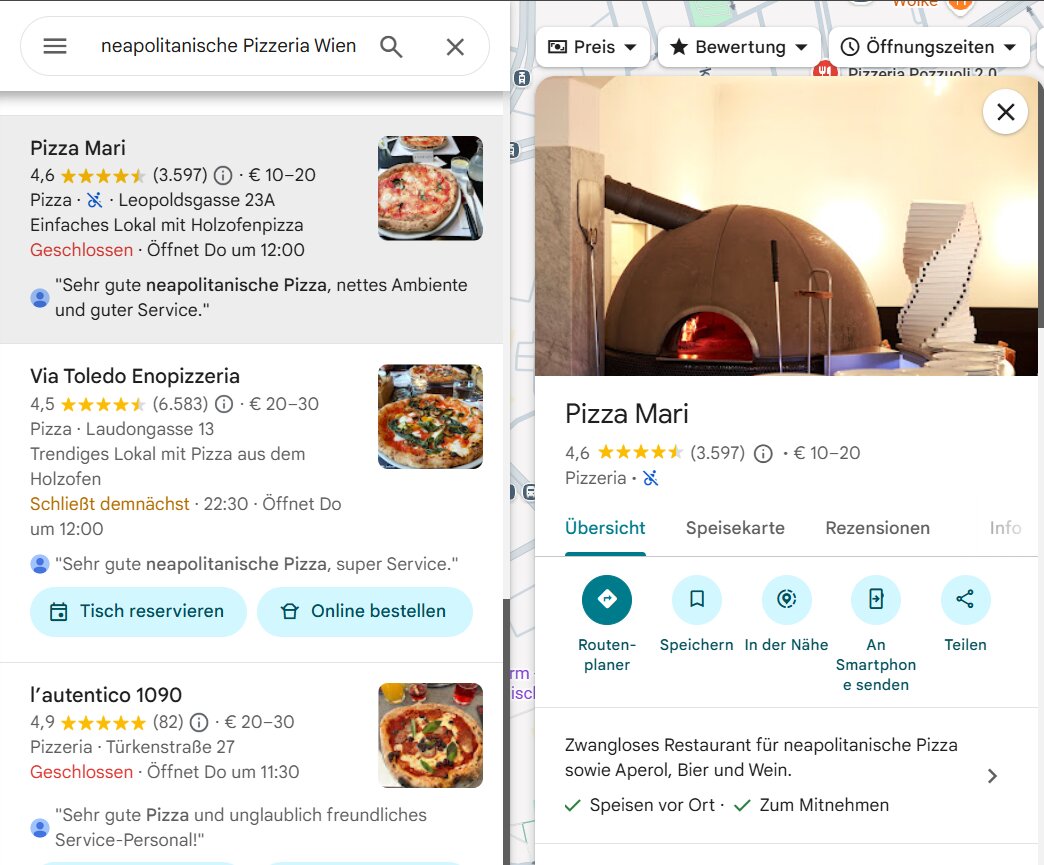
What the image shows: Pizza Mari in 1st place has 4.6 stars. In the right-hand info panel the GBP description is visible: “neapolitanische Pizza” appears explicitly, and the same keyword appears in several review texts. Via Toledo in 2nd place shows the same pattern. l’autentico 1090, however, has the highest average of all three results at 4.9 stars. Yet the specialisation “Neapolitan” is absent from both the description and the review texts. Google evaluates relevance for the entered search query. A higher star average cannot replace that missing signal for a specific search.
This applies increasingly to AI systems as well. ChatGPT, Perplexity and Google Gemini recommend businesses that communicate a clear, consistent specialisation. The specific mechanics behind this are explained in our article on AI Visibility for Restaurants. The key insight from there applies directly: 83 per cent of restaurants are invisible in AI-generated recommendations, even though almost all of them have a Google profile. Completeness alone is not enough. Relevance decides.
Why “Restaurant” as a Category Means Too Much Competition
Google shows a maximum of three businesses in the highlighted map view for local search queries. These three receive the majority of clicks, calls and route requests. Anyone landing in position four or below is practically invisible in practice.
The problem: most restaurateurs compete for the same generic slots. “Restaurant Vienna”, “Restaurant Berlin”, “Restaurant Munich” are among the hardest local keywords there are. Thousands of businesses, three available positions.
Specific search queries operate by different rules. “Neapolitan Pizzeria Vienna” has a fraction of the competitors compared to “Restaurant Vienna”. Anyone who positions themselves clearly as a Neapolitan Pizzeria can realistically win that slot. This applies to every specialisation: gluten-free restaurant, vegan café, authentic ramen bar, alcohol-free bar.
Added to this is a shift in how people search for restaurants. Conversational queries are growing strongly: “Where can I eat gluten-free pizza in Vienna tonight?” rather than “pizza Vienna”. For these queries, a generic positioning is no longer enough. The profile must be the answer to the specific question.
This is not a short-term trend. According to an analysis by FSR Magazine (2026), most restaurant searches are already intent-driven rather than brand-driven. Guests tell Google and AI systems what they want, not which restaurant they have in mind.
And the shift is accelerating. According to BrightLocal’s Local Consumer Review Survey 2026, 45 per cent of consumers already use AI tools for local recommendations, at the start of 2025 it was just 6 per cent. Queries are not getting shorter but more targeted: instead of “restaurant Vienna”, queries like “vegan restaurant Vienna Saturday evening with reservation” are now common. Anyone who does not appear as a relevant result for such specific queries simply does not exist for that guest.
How AI Search and Google Maps Reward Specialisation
Classic Google search and AI systems such as ChatGPT or Perplexity share a fundamental logic: they connect queries with profiles based on relevance signals. The difference lies in the granularity.
An AI query like “gluten-free restaurant Vienna for Friday evening” meets a simple question: which business communicates gluten-free clearly and consistently, has good reviews, current opening hours, and is located in Vienna? Anyone who provides all these signals gets recommended. Anyone listed simply as “restaurant” does not appear as a relevant result for this query.
Google’s Gemini-powered “Ask Maps” feature makes this mechanism even clearer: with a conversational query like “romantic Italian restaurant in Vienna for a date”, the system responds with one recommendation, not a list. The business with the strongest and most consistent relevance signals wins the entire query.
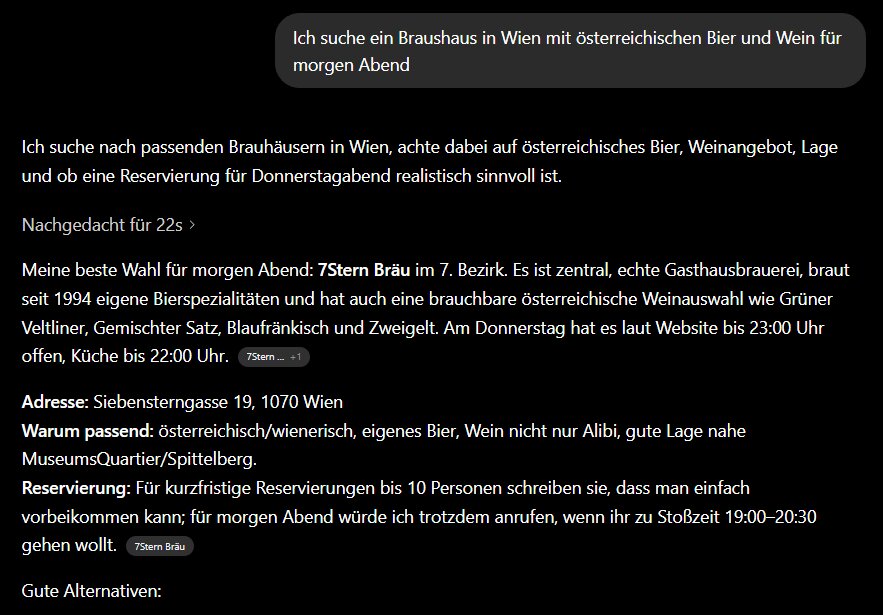
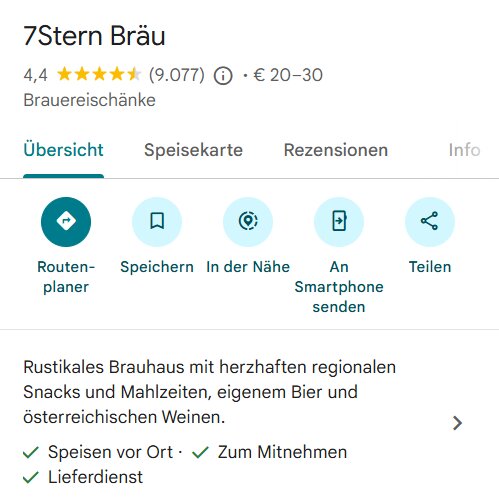
The following example shows this mechanism in practice: in response to the query “I’m looking for a Bräuhaus in Vienna with Austrian beer and wine for tomorrow evening”, ChatGPT recommends 7Stern Bräu as its first choice. A look at the GBP description reveals the strongest relevance signal:
The connection between profile completeness and AI visibility is explained in detail in our article on AI Visibility for Restaurants. The core insight cited there applies directly: 83 per cent of restaurants are invisible in AI-generated recommendations, even though 86 per cent have a Google Business Profile. Completeness alone is not enough. Relevance decides.
That it is worth appearing in those three highlighted results is also supported by the data on reviews as a ranking factor: according to the Whitespark Local Search Ranking Factors Survey 2026, reviews account for 20 per cent of ranking weight in the Google Maps view. That is the second-highest factor of all. Anyone who positions specifically and actively collects reviews is working on both levers at once.
The Positioning Framework: Four Levels of Specialisation
Positioning is not a marketing concept for management consultants. It is an SEO signal. The relevant question is not: “How would we like to be perceived?” The question is: “For which specific search query should we be the best result?” If you do not yet know where your own positioning lies, the answer is often already sitting in existing reviews and guest conversations, more in our article Finding Your Positioning: The Signals Are in Your Reviews.
There are four levels on which restaurants can specialise.
1. Cuisine Style and Preparation Method
Instead of “Italian Restaurant”: “Neapolitan Pizzeria”, “Pasta al Forno”, “Florentine cuisine”. Instead of “Asian Restaurant”: “authentic ramen bar”, “sushi omakase”, “Vietnamese pho”. The specificity must match reality. What is on the plate must also be in the profile.
The more specific the category, the smaller the competition. For Google Maps, that is a clear signal: this business is relevant for exactly this cuisine, not for everything at once.
2. Dietary Requirements and Preferences
“Gluten-free restaurant”, “vegan café”, “halal-certified”, “protein restaurant”. These categories are growing in search volume because the target audiences search for them actively and specifically, and in many cities find very little suitable supply.
For AI systems, dietary details are particularly valuable signals. Someone with a gluten intolerance does not scroll through twenty results to find the right one. They ask a specific question and expect a direct answer. Anyone who communicates this clearly wins that search entirely.
3. Concept and Experience
“Breakfast until 6 pm”, “alcohol-free cocktail bar”, “farm-to-table”. These positionings often face almost no competition because the concept itself defines the search query. Anyone who is the only venue in the city offering brunch into the evening effectively owns that keyword alone.
The concept does not need to be radical. Sometimes a clear distinctive feature is enough: “fresh pasta only, made daily”, “wood-fired pizza to a traditional recipe”, “alcohol-free pairings for every course”.
4. Target Audience and Occasion
“Business lunch Vienna”, “family restaurant with play area”, “vegan fine dining”, “romantic dinner with wine pairing”. Anyone who specialises in an occasion is the most obvious choice for the corresponding search.
The most important rule: one primary positioning is stronger than three mediocre ones. When primary category, description, website and review texts send different signals, they cancel one another out. Secondary categories can be added as complements. The core positioning should be the same everywhere.
Putting Positioning Into Practice in Google Business Profile
A positioning decision has no effect if it is not translated into concrete profile signals. These four elements are decisive.
Choose the primary category: According to an analysis by Search Atlas (August 2025), the primary category is the single strongest ranking factor in the local search result. Google provides over a hundred specific hospitality categories. “Neapolitan Pizzeria” is a different category to “Pizzeria”, which in turn differs from “Italian Restaurant”. Choose the most specific one that matches the actual cuisine.
Use the GBP description: The first 250 characters of the description appear in the preview and are read by AI systems as relevance context. The specialisation belongs here explicitly: the signature dish, the preparation method, the dietary concept. No generic phrases like “cuisine to suit every taste”.
Set attributes comprehensively: Google offers targeted attributes for restaurants: “Gluten-free options”, “Vegan options”, “Reservations recommended”, “Dogs allowed”, “Outdoor seating”, “Wi-Fi”. These attributes appear directly in filtered search queries. Anyone who does not set them does not appear in the corresponding filter searches.
Use review texts as keyword signals: When guests mention “Neapolitan pizza”, “gluten-free” or “vegan options” in their reviews, it strengthens the profile’s relevance for exactly those search queries. Targeted review requests, combined with a brief indication of what was particularly worth mentioning, encourages keyword-rich review texts. The complete strategy for this is explained in our article Get More Google Reviews: A Guide for Restaurants.
The implementation of these steps in detail, with a step-by-step guide for each profile area, is covered in our Google Business Profile Checklist for Restaurants. If you would prefer direct support, the SupaPresence team is happy to help: from profile analysis and category selection to ongoing review management. View all plans and packages.
Positioning Consistency: One Signal Across All Channels
A clearly chosen specialisation only develops its full effect when it is communicated consistently across all channels. Google and AI systems aggregate information from many sources simultaneously. When several platforms confirm the same positioning, the signal is stronger than what any single source can achieve alone.
Contradictory signals cancel one another out. Consistent signals reinforce one another.
These channels are relevant for restaurants:
Website: The title tag, meta description, H1 and the first paragraph should explicitly name the specialisation. AI systems crawl the website as an independent source. If the website talks about “modern European cuisine” but the GBP says “Neapolitan Pizzeria”, that creates a contradiction that algorithms interpret as relevance uncertainty.
GBP posts: Regular posts showing specialities and concept send activity signals and keyword signals simultaneously. A Neapolitan Pizzeria that publishes posts featuring “wood-fired pizza” and “authentic Neapolitan cuisine” builds consistently on the primary category.
Review texts: When guests mention the specialisation in reviews (“gluten-free pizza here is incredible”, “best vegan breakfast in Vienna”), it directly strengthens the profile’s relevance for exactly those search queries. Targeted review requests with a brief hint about what was particularly worth mentioning encourages keyword-rich texts.
Third-party platforms (TripAdvisor, TheFork, Yelp): Category, description and keywords must match the GBP positioning. According to Whitespark, 60 per cent of the sources in AI-generated answers come from third-party platforms, not from the business’s own website. Anyone listed as “International Cuisine” on TheFork but as “Neapolitan Pizzeria” on Google halves the signal strength.
Social media: The profile description on Instagram and Facebook should communicate the same core positioning. AI systems are increasingly crawling social media profiles as source information. What appears in the GBP should also be recognisable in the Instagram bio.
Photos: Images that consistently show the signature product send visual consistency. On Google photos and the business’s own website, filenames and descriptions are evaluated. Ten photos of wood-fired pizza communicate more than two pizza photos alongside thirty mixed dishes.
The principle is the same as in the framework: one clear primary positioning, communicated identically everywhere, is stronger than many half-hearted signals across many different topics.
Common Mistakes in Restaurant Positioning
Full tables, a team coordinating dozens of things at the same time, not a moment to breathe. We all know this. In that daily reality, positioning mistakes usually arise not from ignorance but from lack of time.
Set up too broadly: “We have something for everyone” sounds welcoming but is the opposite of useful for algorithms. Every added specialisation dilutes the relevance for the others. A sushi restaurant that also serves schnitzel, pizza and vegan bowls sends too many competing signals. The algorithm cannot establish what the business is really about.
Wrong or too generic primary category: Anyone choosing “Restaurant” when “Japanese Restaurant” or “Sushi Restaurant” are available is giving up the single most important ranking lever. The category takes two minutes to change and has lasting effect.
Contradictory signals across channels: The website promotes Neapolitan cuisine, the GBP is categorised as “Italian Restaurant”, TheFork has “international cuisine” entered. Every contradiction weakens the overall relevance. How consistency is implemented concretely across all channels is covered in the section above.
How the SupaPresence Team Approaches This
We help restaurant operators ensure that review responses, GBP activity and profile signals all align consistently with the chosen positioning. A kitchen that specialises clearly and communicates that actively has a structural advantage in Google Maps and AI searches. Start your free trial.
Frequently Asked Questions
Why can’t I find my restaurant in Google Maps?
The most common cause: the profile is set up too generically. Anyone categorised as “Restaurant” competes with every business in the area. More specific categories such as “Pizzeria” or “Vegan Restaurant” reduce the competition to the search queries that are actually relevant for your venue.
Which Google Business Profile category is right for restaurants?
The primary category is the single strongest ranking factor in Google Maps. Choose the most specific category that fits, not the broadest. “Neapolitan Pizzeria” is stronger than “Italian Restaurant” because it means less competition on the search queries your guests actually type.
How does restaurant positioning help with AI recommendations?
AI systems such as ChatGPT and Perplexity match queries like “gluten-free restaurant Vienna on a Friday evening” with profiles that communicate those signals clearly. Anyone who communicates their specialisation consistently across GBP, website and third-party platforms is recommended more often for such specific queries.
Should a restaurant limit itself to one specialisation?
A clear primary positioning is stronger than several weak ones. Google values consistency: when primary category, GBP description, website and review texts all signal the same specialisation, they reinforce one another. Secondary categories can be added as complements, but should not dilute the primary positioning.
How quickly does new positioning take effect in Google Maps?
First effects from a changed primary category can become visible within a few weeks. Stable improvements in specific search queries typically appear after two to four months, when the signals are communicated consistently across profile, website and reviews.