Improve Your Google Review Average: More Stars
Improve your Google reviews: calculate exactly how many new 5-star reviews your restaurant needs for a better average rating score
A guest compares two restaurants on Google Maps, both a ten minute walk away, similar price range. One sits at 4.0 stars, the other at 4.5. He does not click through a single review. He picks the second restaurant, purely because of half a star. Improving your Google reviews ultimately means exactly this: making sure the number next to your name works for you instead of against you.
Why half a star decides guest choices
75% of consumers always or regularly read online reviews before visiting a local business, according to BrightLocal. (Source: Local Consumer Review Survey 2024, BrightLocal) The star rating is the first thing that catches the eye, before a single review text gets read.
A widely cited Harvard Business School study puts a concrete number on the economic effect: one additional star on Yelp corresponds to 5 to 9% higher revenue for independent restaurants. The effect was measured on a specific platform, but the underlying principle, stars as a purchase decision signal, applies just as much to Google Maps, where most guests in Europe start their restaurant search.
We have all done this ourselves: scrolling through a results list and filtering by stars first, before even properly reading a single name. Guests do exactly the same with your restaurant.
How strongly a profile’s response behaviour affects perception shows up here too: 88% of consumers would choose a business that responds to all its reviews, compared to just 47% for a business that does not respond at all. (Source: Local Consumer Review Survey 2024, BrightLocal) The average alone does not decide how a profile comes across, but it is the first and most visible filter.
Why your average barely moves past a certain point
Here is the part many restaurant owners underestimate: the more reviews a profile already has, the less weight each individual new review carries.
A restaurant with 20 reviews and a 4.0 average only needs a handful of new 5-star reviews to visibly climb to 4.3 or 4.4. A restaurant with 300 reviews at the same 4.0 average would need a three-digit number of new 5-star reviews to make the same jump. The sum of all existing stars is simply already much larger, so any single new rating barely shifts it in relative terms.
A study by Ohio State University, analysing around 3,000 restaurants on Yelp and TripAdvisor, confirms a related effect: the more reviews a restaurant receives overall, the higher its average rating tends to be. The authors also found a self-reinforcing mechanism: if one of a restaurant’s first reviews comes from a dissatisfied guest, it discourages future guests from visiting and reviewing, meaning the profile receives fewer new reviews overall and the early negative impression persists for longer. (Source: Ohio State University 2020 via ScienceDaily) This is a correlational study, not proof of causation, but the pattern is clear: asking for reviews early prevents a single bad start from permanently shaping your average.
We covered this same principle in our article on review frequency: consistency beats one-off pushes. The same logic applies to your average, just with an extra calculation attached.
How to calculate exactly how many reviews you need
Instead of guessing how many new reviews you need for a visibly better average, it pays to simply do the maths. The formula behind it is straightforward: you need enough new reviews at a given star rating until the total sum of all stars, divided by the new total count, matches your target average.
An example makes this concrete: a restaurant with 40 reviews and a 4.0 average wants to reach 4.3. With exclusively new 5-star reviews, that takes 18 additional reviews. With 150 existing reviews, the same jump from 4.0 to 4.3 already takes 65 new 5-star reviews, direct proof of the effect described above.
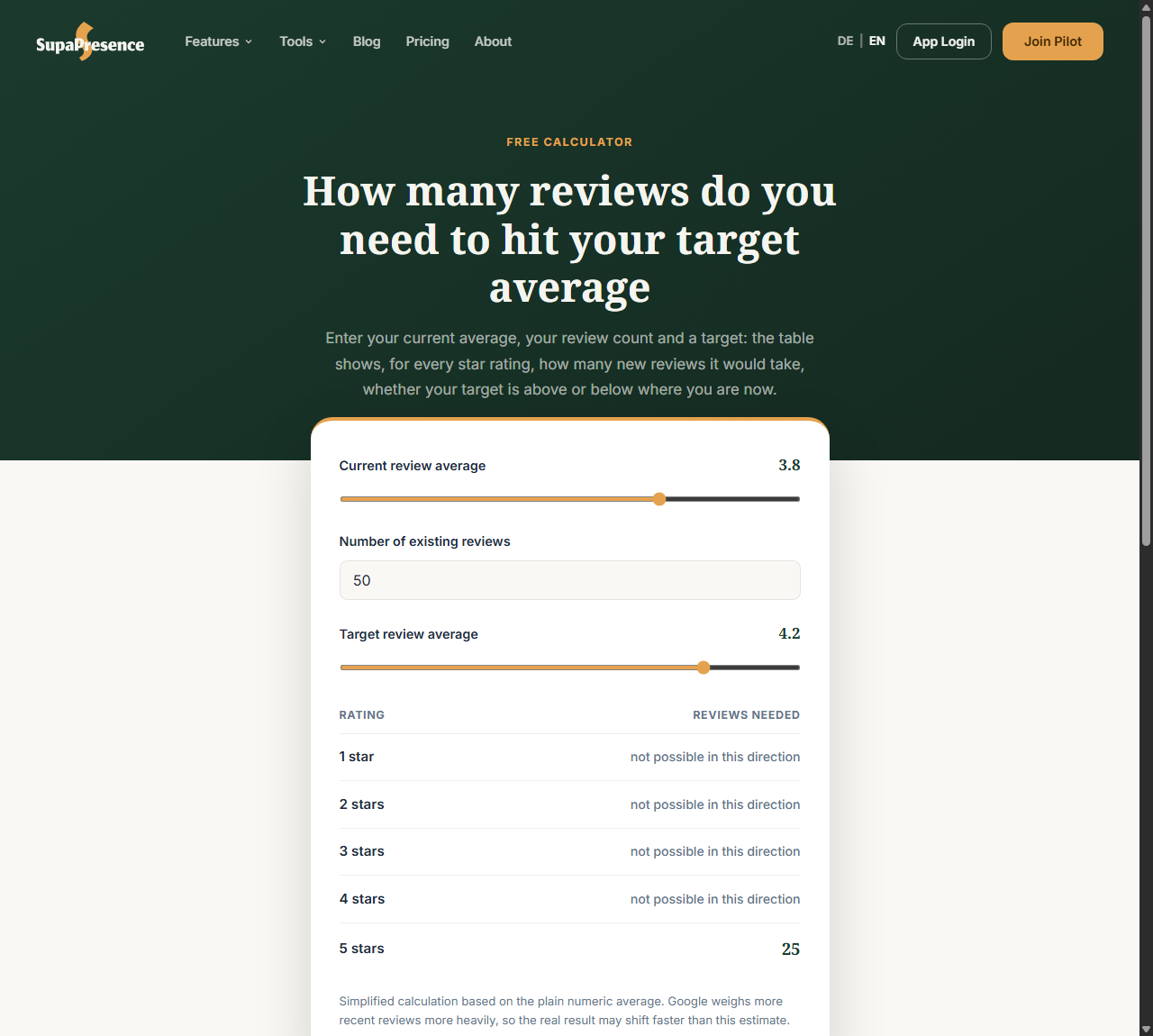
So you do not have to run this calculation by hand every time, we built our review average calculator. Enter your current average, your review count, and your target, and the calculator instantly shows how many new reviews at 1 to 5 stars would be needed, and whether your goal is even realistic given the reviews you can expect to get.
The three levers to shift your average deliberately
The maths shows you the target, these three levers get you there.
1. Collect more current reviews. The most effective lever against a sluggish average is simply volume: more reviews mean more opportunities to move the average in the direction you want. For a systematic, non-pushy approach, see our guide Get More Google Reviews: A Guide for Restaurants.
2. Prevent negative reviews before they happen. Every avoided bad review works twice over: it does not pull the average down, and it prevents the deterrent effect on future guests described in the Ohio State study. The three most common causes of avoidable negative reviews, and how to tackle them, are covered in Avoid Bad Reviews: Restaurant.
3. Respond quickly and professionally to existing reviews. A public, level-headed response to a negative review does not change the star rating, but it shapes how new guests perceive your profile overall, see the 88% figure above. Responding quickly also often prevents an unhappy guest from escalating their review further.
In short
Your Google review average is not a fixed number, it is the result of a simple calculation that shifts with every new review. The more reviews you already have, the more new ones it takes to achieve the same jump, one more reason to act early and consistently instead of only reacting once the average has visibly dropped. SupaPresence supports you across several of these levers at once: collecting new reviews, responding quickly in your own voice, and surfacing insights that show which themes are building up in your reviews before they noticeably affect your average. Join the pilot for free.
Frequently Asked Questions
How do you calculate a Google review average?
The average is the sum of all star ratings divided by the number of reviews. With 100 reviews totalling 420 stars, that works out to an average of 4.2. Every new review shifts that sum, how much depends on how many reviews already exist.
How many 5-star reviews does a restaurant need for a higher average?
That depends on your current review count and your target average. With few existing reviews, five to ten new ones are often enough. With several hundred reviews, you may need far more. Our review average calculator gives you the exact number for your own figures.
Why does my review average barely move despite new good reviews?
The more reviews a profile already has, the less weight each individual new review carries in the average. A restaurant with 20 reviews sees its average rise noticeably after five new 5-star reviews, a restaurant with 300 reviews barely moves at all. That is simple maths, not a sign that something is wrong.
Can old negative Google reviews still be offset?
You can only get a review removed directly if it violates Google’s policies. But you can raise your overall average by consistently collecting new positive reviews. It usually matters more to understand why the negative review happened in the first place, so the pattern does not repeat.