Google Now Summarises Reviews With AI: What Restaurants Should Know
Google now summarises your reviews with AI ('Helpful tips'). Since when this exists and how to use the summary to your advantage
A guest opens Google Maps looking for a restaurant for the evening. Before they even open a single review, they see three bullet points: what makes the place special, what the atmosphere is like, and whether service slows down when it’s busy. That’s not an editorial entry. Google’s AI writes it, automatically, from your reviews.
What “Helpful tips” is and since when Google shows it
Since spring 2026, Google Maps has been showing a new section labelled “Hilfreiche Tipps” (“Helpful tips”) with a “New” tag on many restaurant profiles in the German-language app, the English-language label may differ as the rollout continues. The feature is an AI-generated summary, powered by Gemini, distilled directly from existing guest reviews.
By the time the feature showed up on your profile, Google had already been testing it in the background for over a year. Through the Places API, Google first made AI-generated summaries for places, areas and reviews available to developers. General availability with regional expansion was announced on 23 September 2025. (Source: Google Maps Platform Blog) Visible directly on the Maps profile, the feature arrived later, rolled out in stages with no official announcement for German-speaking markets. That’s why some restaurants have seen the section for weeks while others haven’t seen it at all yet.
The AI reads all of a restaurant’s reviews and extracts patterns. Dishes that come up across multiple reviews. Descriptions of atmosphere. Recurring criticism. From these patterns, three to five bullet points emerge, which Google presents as “tips from visitors”.
Two real examples from Vienna show what this looks like in practice. At the first venue, visitors particularly recommend the moussaka and the lamb shank, while reviews also mention that service occasionally slows down when the restaurant is busy, not a compliment, but an honest signal. At the second venue, guests highlight the view of the Maria Treu church and the popular cheesecake, and note that only cash payment is often accepted on weekends.
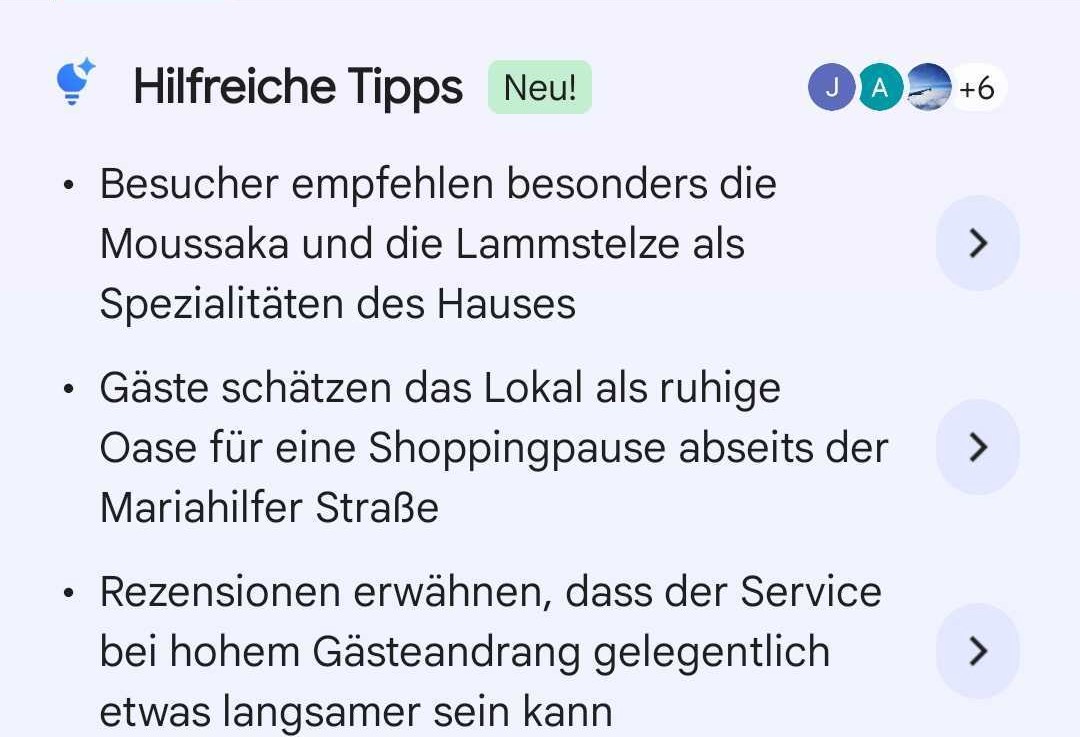
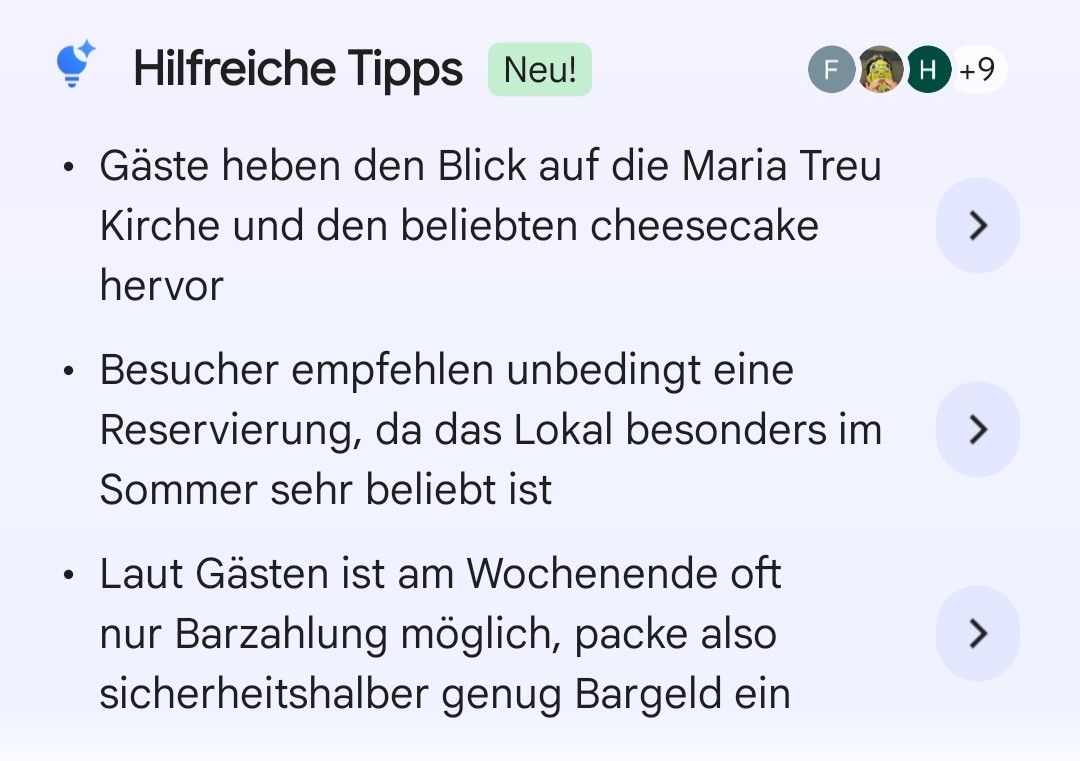
The AI surfaces weaknesses just as readily as strengths, as long as they come up often enough in reviews.
Why your reviews now serve as raw material for your Google profile
Until now, a review was text that interested guests could read. With “Helpful tips”, reviews become raw material for how your profile is presented: they feed a summary that everyone sees when they open your profile.
That fundamentally shifts how review quality is weighted. Star count alone no longer decides how your profile comes across. What’s written in the review text matters now too.
A 5-star review that just says “Everything was great” gives the AI little to work with. A 4-star review that describes the daily menu, the wine list and the quiet terrace atmosphere is far more likely to be pulled in as a source.
This effect is amplified in hospitality specifically: Yext data from 2025 shows that 13.3% of all AI citations in the restaurant sector come from reviews and social content, the highest share of any industry. (Source: Yext Research, AI Citations 2025) For no other segment is review text as directly relevant as an input for AI-generated content as it is for hospitality.
What the AI picks up from your reviews, and what it leaves out
The system follows its own logic. Once you understand it, you can influence what shows up in the summary.
What the AI favours:
- Specific dishes: “Moussaka”, “lamb shank”, “lunch menu” get extracted. “The food was tasty” does not.
- Atmosphere and context: “Quiet”, “family-friendly”, “good for business dinners” are clear signals. The AI recognises which situations a restaurant serves.
- Repetition: Whatever three or more guests mention independently ends up in the summary.
What the AI leaves out:
- General impressions without concrete detail
- Short one-liners without explanatory context
- Contradictory statements that cancel each other out
Negative points appear once they recur. A single guest writing about wait times doesn’t shape the summary. Five guests observing the same thing does. For you, that’s honest feedback about systemic weak points.
Four levers to actively improve your Helpful tips
Full tables, a team juggling a dozen things at once, and now a Google feature to keep an eye on too, the pressure is real. The following points can still fit into your existing routine.
1. Encourage guests to be specific. A prompt like “Feel free to mention what you particularly enjoyed and which dish you’d recommend” gives guests clear direction. That increases the level of detail in reviews and, with it, the quality of the AI summary.
2. Reuse positive themes from Helpful tips in your own channels. If the AI highlights a particular dish or the quiet atmosphere, that’s guest-validated, free social proof. Use those exact phrases in your GBP description, on social media or on your website, instead of letting them disappear unused on your Maps profile.
3. Respond to reviews that contain misunderstandings. If a review describes a situation caused by a one-off circumstance (peak season, staff shortage), you can clarify that in your response. The AI doesn’t read responses directly for the tips, but a public reply signals to guests reading your profile that you take feedback seriously. More on this in Why Every Google Review Deserves a Response.
4. Take recurring weaknesses seriously. When “Helpful tips” surfaces a criticism, that’s a sign several guests independently noticed the same thing. That’s not a PR problem. That’s an operations problem. The AI just makes it visible.
What Google is planning next: Ask Maps and AI-assisted ordering
“Helpful tips” isn’t a standalone project. Google is systematically building out the AI layer around local search.
Ask Maps has been live since 12 March 2026, but so far only in the US and India, on Android and iOS. You’ll find it via a dedicated “Ask Maps” button directly in the Google Maps app, and you can search conversationally by text or voice: “Show me a quiet restaurant with a good wine list downtown for tonight.” The system pulls data from GBP profiles, review text, photos and menu information and returns a single recommendation rather than a list. Google hasn’t given a launch date for Europe yet, likely due to ongoing review under the Digital Markets Act, particularly for the personalised part of the feature that draws on location history and saved places. (Source: TechCrunch)
An AI ordering feature hasn’t been officially announced. It surfaced in code strings found inside a Google Maps beta build for Android. Contrary to what you might expect, this wouldn’t work over a phone call or an email to the restaurant: the idea is agentic ordering built directly into the app, you tell the AI in natural language what you want to eat, and Gemini handles the selection and checkout, presumably using payment and delivery details already stored in your Google account. It’s still unclear whether pickup only or delivery too would be supported, how the order technically reaches the restaurant, and what role existing delivery platforms would play. A public test in select US markets is expected by late 2026, with a wider global rollout not before 2027, both unconfirmed. (Source: Android Headlines) Despite the uncertainty, the implication is clear: profiles that are incomplete or poorly structured get systematically skipped by automated recommendation and ordering systems.
What this means today: According to 2026 industry reports, a significant share of restaurant-related search queries already trigger an AI summary, with a clear upward trend compared to early 2025. Businesses cited in an AI summary gain, on average, 35% more organic clicks than uncited profiles on the same search result, according to an analysis by Seer Interactive (November 2025). (Trigger rates vary considerably by search intent, specific “restaurant near me” searches show different figures than general informational queries. The direction is unambiguous either way: visibility in AI summaries is becoming its own competitive factor.)
For a broader look at AI search and how restaurants can position themselves: AI Visibility for Restaurants: What Matters Now.
The bottom line
“Helpful tips” makes visible what’s already sitting in your reviews, just condensed and given a prominent spot. You can’t write the summary directly, but you can shape the raw material it’s built from: encourage specific reviews, reuse positive mentions, respond to misunderstandings, and treat recurring criticism as what it is, a signal for genuine action. That ongoing listening and responding is the core of solid review management, with or without Google’s AI summary. SupaPresence takes this off your plate: from profile optimisation to automated responses in your own tone, to insights that show which themes are building up in your reviews before they ever reach Google. Try it for free.
Frequently Asked Questions
What is the “Helpful tips” feature on Google Maps?
Helpful tips is an AI-generated summary that Google creates from a restaurant’s reviews. It appears directly on the Google Maps profile and condenses recommendations, atmosphere and frequently mentioned criticism into bullet points. Guests see this summary before reading individual reviews. In the German-language app it is labelled “Hilfreiche Tipps”, the exact English-language label may vary as Google continues to roll the feature out.
Can you influence what appears under “Helpful tips”?
Not directly. The AI draws its content exclusively from existing reviews. Indirectly, you can influence what it finds: encourage guests to mention specific details (dishes, occasion, atmosphere) and respond to reviews that contain misunderstandings.
Do negative points also appear in “Helpful tips”?
Yes. The AI also surfaces recurring criticism, once it appears across multiple reviews. That makes consistent quality management more important than ever: repeated weaknesses become visible automatically.
How do “Helpful tips” and Google AI Overviews relate to each other?
Both are expressions of Google’s AI strategy for local search. Helpful tips appear inside the Google Maps profile itself. AI Overviews appear in Google search results. Both draw on the same sources: reviews, profile information and website content.
What should you tell your guests so the AI generates better summaries?
Ask your guests to be specific: mentioning dishes, the occasion for their visit and the atmosphere helps the AI generate specific, positive tips. Generic lines like “everything was great” give the AI little to work with. The more detailed a review, the more likely it is to be used as a source.